


Welcome to a new issue of Words That Matter! Each week, we invite a guest curator to share the reading that matters most to them.
Visakan Veerasamy (@visakanv) – known simply Visa on the internets – is a writer best known for his long-running Twitter/X body of work and the books Friendly Ambitious Nerd and Introspect. He also writes a Substack, visakanv’s Funhouse Mirror, about creativity, introspection, scenes and subcultures, and how people make sense of one another online.
Please enjoy these works and words that have mattered to Visa!
Visa’s Picks
The Information: How the Internet Gets Inside Us
Adam Gopnik | February 2011 | The New Yorker (archive)
This remains my favorite essay of all time. It was written after the smartphone was invented, but before they became ubiquitous. It opens with a great point about how the tech-enabled reality we inhabited in 2011 was already more magical than the world of Harry Potter (first book published in 1997), with kids wondering why Harry and friends had to go to libraries to hunt down spellbooks. Why not just Google it? It goes on to cover some great broad strokes about the history of reactions to developments in media technology: It’s amazing! It’s terrible! It’s kind of the same, really! And how all of them have been right and wrong in varying ways. I think what I really love about this essay is how it’s a great overview of the recurring patterns we’re living in, patterns which might not be obvious to us in the moment, but reveal themselves to anybody who’s done the reading. Adam Gopnik did the reading, and the clarity of his understanding in 2011 somehow has become even more relevant in 2026.
Freshman address at the Boston Conservatory
Karl Paulnack | 2003 | Speech transcript (text transcript)
This speech moved me very deeply when I was an anxious, confused teenager, and has remained central to my understanding of art, and life. Artists are spiritual first responders. They tend to the souls of weary people. When we need art, as Ethan Hawke put it, it’s not a luxury, it’s sustenance. Art, poetry, music, they help people feel things that they need to feel.
Writing this now, I’m noticing a pattern in many of my favorite things: they help me contextualize my small little life in the grander story of humanity, with all its triumphs and tragedies. They help me see where and how I belong.
Everything is a Remix
Kirby Ferguson | ~2010 | YouTube video
Watching this video greatly reduced my creative anxiety as an author. It shifted something inside me about my understanding of how things are made. I came to see that there isn’t much point in “trying to be original” in isolation. You’re much more likely to get to making interesting work by first seeking out as much interesting work as you can find, and recombining it. Try to be interestingly unoriginal. Seek out varied influences from near and far. There’s also an interesting point about perception: even if you somehow were able to create something “truly” original, your audience will not be able to make sense of it except in terms of what they already know, in terms of what came before. So again, you might as well get good at remixing, because it’s the only option there really is.
The theme continues: you find out that Led Zeppelin and Star Wars and Michael Jackson and anything of note is always something part of a lineage, whether they acknowledge it or not. And I feel the world really opens up, feels much more like a large family of relationships rather than an overwhelming collection of disconnected objects.
How to help someone use a computer
Phil Agre | 1996 | Blog post
This is an old guide on how to help someone use a computer. But it’s also so much more than that. In its masterful simplicity and generosity, it simultaneously educates us on “how to be a parent,” or really “how to help anyone with anything.” A nice example of the universal being found within the particular. Striking lines include “You’ve forgotten what it’s like to be a beginner” and “Your primary goal is not to solve their problem. Your primary goal is to help them become one notch more capable of solving their problems on their own.” Please just read the whole thing, it’s short.
You can’t tell people anything
Chip Morningstar | April 2004 | Blog post
This is a very clever piece of writing about a very fundamentally human problem: communication is hard. We are quick to think we understand what someone is saying to us, and to say that we do, even when we actually don’t. You could say there’s a cynicism to it, but I think it’s a healthy sort of cynicism that reveals a deeper optimism, the way George Orwell said “every book is a failure” while choosing to write books anyway. If you’re serious about communicating, you have to acknowledge how it fails, otherwise you’re just deluding yourself about the efficacy of what you’re doing, and it’s not going to be sustainable long-term.
A good place to work
Ben Horowitz | 2012 | Blog post
I believe I first encountered this post when I was working at my last job over a decade ago, and I still share it with my own clients to this day. It’s a very economical telling of a very striking story: a manager at Ben’s company hadn’t done a 1:1 meeting with any of his employees in 6 months. Ben thinks through why this is, and then talks to the manager’s boss about it. He frames the problem in an incredibly compelling way: if the employees aren’t meeting with their manager, the manager has no way to know whether the organization is actually working well, and if that doesn’t change, both the manager and his boss would have to be fired.
Why do I share this post all the time? Aside from it being an example of very clear writing and thinking, I’d say everybody is essentially the CEO of their lives, and we’re each in charge of making sure that our lives are a good place to live. But not many of us do a great job of really thinking this through and attending to the details of it. I often have conversations with people who need a little kick in the ass about this, and Ben’s post is excellent at delivering that. I often need it myself.
Randy Pausch’s Last Lecture: Achieving Your Childhood Dreams
Randy Pausch | 2007 | YouTube video / transcript
I first watched this video soon after it was released, and have rewatched it every other year or so. It’s still one of the realest things I’ve seen, someone who really cared about others. It definitely deeply influenced me in thinking about things like, how great it is to enable the dreams of others. How great it is to truly earn the trust and respect of others. Randy is a model of nourishing masculine energy that I was hungry for all my life, and never quite encountered around me except maybe in tiny fragments.
Eve Ensler: Happiness in body and soul
V (formerly Eve Ensler) | 2004 | TED Talk
There are lots of good things about this talk, beginning with the idea that you don’t necessarily know what your life’s work is going to be in advance, and following with the question of “How could you be happy and live in this world of suffering and live in this world of pain?” V goes on to tell harrowing, intimate stories of violence against women, and courageous stories of the women who fought back on their own terms, and how she discovered that “when we give in the world what we want the most, we heal the broken part inside each of us.” That’s stayed with me forever since I witnessed it.
Chris Rock on Ferguson, Cosby and Obama
Chris Rock | November 2014 | Interview in Vulture (archive)
Chris Rock is great in interviews. This interview was interesting when it came out, and it’s doubly interesting now that it’s from 12 years ago. On my latest reread I find myself thinking about his description of what I’d call a healthy, clear-eyed contrarianism, where you observe what everyone is doing and think about something truly different to do. I’m sharing this particular interview because it’s one I’ve revisited multiple times, but honestly you can just google “Chris Rock interview” and read any of them. It becomes very unsurprising that he’s so successful at what he does. He’s a very clear thinker and communicator.
A Master Class in Jazz Performance and Creativity with Pianist Kenny Werner
Kenny Werner | 2005 | YouTube video
The most amazing thing about Kenny Werner to me is how he’s able to tell people, with love, that their problem is their ego. It’s a skill that I’ve been trying to cultivate myself, though I suspect it only comes with decades of deep practice and honesty and acceptance. I love this video so much. It’s superficially about how to get better at playing jazz piano, but you don’t need to be a pianist to see that it’s really about how to manage your own psychology, which is really about how to live your life.
Spotlight on Visa’s work
Visa is best known for his Twitter/X body of work at @visakanv, which grew into his books Friendly Ambitious Nerd (2020) and Introspect (2022). His Substack, Funhouse Mirror, is where he explores art-and-media questions, including The Tavern and the Temple and Notes on literacy. A good place to start is Are you serious?, one of his most popular posts.
Brought to you by…
Today’s issue is brought to you by Matter.
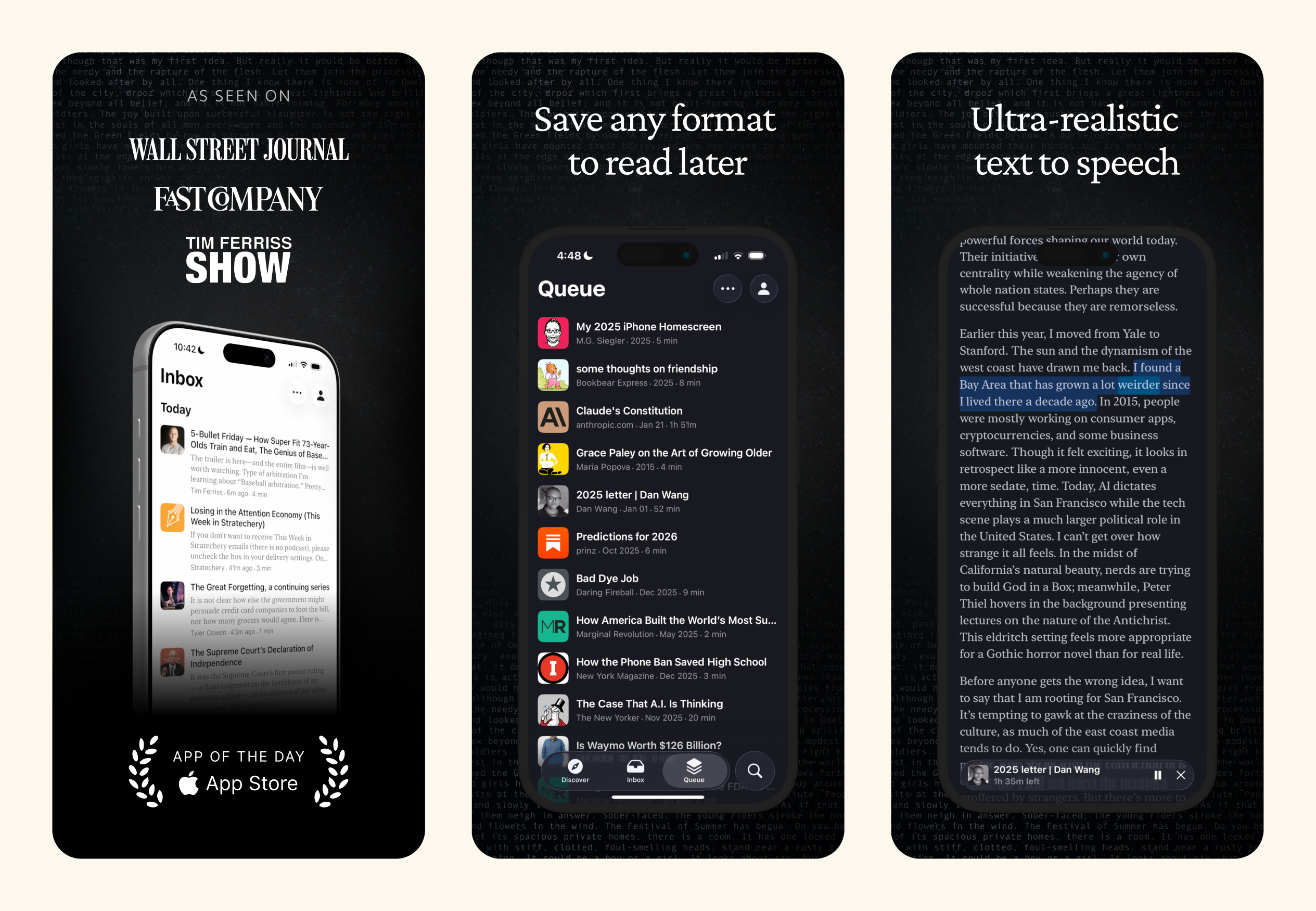
Matter is the modern read-later app for serious readers. Since Pocket shut down last fall, tens of thousands of readers have made Matter their new home.
Designed for Apple, Matter has earned multiple App of the Day honors and won MacStories’ 2025 Feature of the Year for its ultra-realistic text to speech. It’s been recommended by Tim Ferriss, Patrick Collison, the Acquired Podcast, and The Wall Street Journal, among others.

Very cool recommendations. Randy Pausch's last lecture was recommended by a prof when I was in college, and it created a feeling of awe among my friends and I. It's been a while since I watched it, thanks for reminding me.
"we’re each in charge of making sure that our lives are a good place to live." That's a neat way to think about it.