Welcome to a new issue of Words That Matter! Each week, we invite a guest curator to share the reading that matters most to them.
Sarah Sherman (@sshhherman) is a creative director and cultural strategist at SpecialGuest, where she’s led creative work for Lyft, OpenAI, and Bumble. She’s also a documentary filmmaker, writer, and sometime creative coach for emerging talent. Before SpecialGuest, she helped build the The Atlantic’s Brand Studio and worked on Emmy- and Peabody-winning documentary projects for CNN, Al Jazeera America, CMT, Netflix, and PBS.
Her Substack, Radical Hearsay, focuses on “gut feelings, nauseating memories, and occasionally fiction that’s not always announced as such,” to use her words. You can find her on Substack at @sshhherman and on her website.
[Ben’s note: Hot new Substack alert! Sarah recently restarted her Substack with a personal essay that will rock your socks. It’s free for now, get in.]
Please enjoy these works and words that have mattered to Sarah!
Sarah’s Picks
Victory Lap
George Saunders | 2009 | Short Story
This George Saunders story, the first in his Tenth of December collection, is a masterclass in how to pull the heart out of your reader’s chest cavity, hold it in your hand, and then gently place it back, changed. It is difficult, both in form and subject matter, and demands you pay real, deep attention to every tiny beat of the moments in which it takes place. But it’s one I will read again and again, finding something new and perfect every time.
My 14-Hour Search for the End of TGI Friday’s Endless Appetizers
Caity Weaver | 2014 | Essay
I learned more about humor, voice, and whole-ass writing from this piece than anything else I have ever read. I also will never look at mozzarella sticks the same way again. If you want to cackle so hard that anyone within earshot (through the bathroom door, next to you on the train, beside you in bed) has to ask what you’re possibly reading, read this — and really anything by Caity Weaver, while you’re at it. (Her GQ profile era was particularly standout: Dwayne Johnson for President)
Art & Fear
David Bayles & Ted Orland | 1993 | Book
This is a short book that I found to be singularly direct and convincing in the way it speaks to people who aspire to make any kind of art. The central communication (or the one that landed most centrally for me) is that every shitty little thing you tell yourself about your craft — whether that’s painting, playing music, writing — is, by definition, part of the process. They are voices to be normalized, not heeded, as you push yourself to keep going. It’s the kind of book that anyone who wants to take risks and make stuff should keep in the drawer of their bedside table, among hair ties and discarded earplugs and vibrators, like mine. (Thank you to my friend Sarah Ransohoff for putting it on my radar.)
a vacation from the future
Sean Monahan | 2025 | Newsletter Essay
I open Sean Monahan’s 8ball newsletter, more than any other newsletter I get, and I get a lot. Reading him feels like LARPing; suddenly, I’m in Los Feliz, hungover, drinking cold brew, ripping cigarettes, and nodding vigorously along to my friend’s brilliant takes. Sean Monahan is a trend forecaster and consultant who is credited with coining “vibe shift” and “normcore.” He regularly delivers feverish but somehow precise brain dumps about what he’s seeing and experiencing in culture. When I forwarded this particular post to a few friends, I wrote “this is a little unhinged and raw but so fucking on point.” That is Sean. An excerpt:
All that GDP and what does American life look like for the next generation? Cavernous white condos where we hide under microplastic shedding blankets with our phones on Do Not Disturb while we scroll and scroll and scroll, waiting for the DoorDash delivery to be left at our door with a ghostly knock we are too agoraphobic to answer.
The Silence
Junot Diaz | 2018 | Essay
In some ways, this is a proxy for Junot Diaz’s whole body of work. The Brief Wondrous Life of Oscar Wao and Drown are among my very favorite books. While those are fiction, this is a personal essay about childhood trauma. It stays with me, not so much as the content itself, but as the physical memory of what it feels like to be so gripped by a story that you have to stop what you’re doing (in my case, walking home from the subway in Brooklyn), sit down (on a park bench), finish it with 100% of your focus (despite pigeons and sirens), and stay there for a few minutes afterwards processing what you’ve just read. Tell me: what is better than that? It’s worth noting that the cultural and societal context for its publication is complicated. Unfortunately, people theorized at the time that he published it in order to distract from sexual harassment allegations that he knew were coming. For what it’s worth, he still teaches at MIT and publishes regularly. Regardless, this isn’t the place for that discourse.
Almost everyone I’ve met would be well-served thinking more about what to focus on
Henrik Karlsson | 2024 | Essay
I am prone to the unforgivably corny practice of writing existential reminders on post-its and sticking them to the rim of my monitor. “Open loops” is one of them, referencing an excerpt from Karlsson’s post:
Unintentionally, I would tell my brain to focus on something else—a conflict in a TV series I was watching, for instance. I would watch an episode before bed, and the cliffhanger would open a loop in my head. That loop would be churning in my head as I slept; I woke to a blank page. I don’t have time for that anymore. I make sure to always have an open loop concerning my writing. And I close every other loop—by wrapping it up as fast as I can, or by writing it down on a list, or, preferably, by not opening the loop at all.
I have found that advice in which the spiritual and practical collide like this is often the most powerful.
The “Quiet Catastrophe” Brewing in Our Social Lives
Ezra Klein | 2023 | Podcast
After I listened to this podcast, I was genuinely inspired to explore co-living with friends and their families. For many reasons, this became less of a priority (in the near term, at least). But the discussion around the inevitable friction and discomfort that comes with cohabitation — particularly the idea of choosing “community problems” over individual ones — felt so true and fresh, and it stays with me as I endeavor to inconvenience myself more in service of the people I love.
The Disadvantages of an Elite Education
William Deresiewicz | 2008 | Essay
This is the essay that preceded Deresiewicz’s 2015 book Excellent Sheep: The Miseducation of the American Elite. It’s a little dated and meandering, but as a parent of a toddler, it rocked me. I felt so seen in the quiet pain I have often felt in not being able to hear my own inner voice — and the regret I used to feel about falling victim to the achievement industrial complex. It marked the beginning of my engagement with the idea that college might not be a good thing for my own child, which is, of course, a perspective that is becoming increasingly mainstream. This interview with Deresiewicz, starting around the 24-minute mark, gets at a lot of these ideas and more.
Honey
Robyn | 2018 | Song
Because Robyn is a goddess and doesn’t need real beat drops to make your mitochondria shimmy. Good background music for reading all of the above.
Spotlight on Sarah’s Work
Follow Sarah on Substack at @sshhherman and subscribe to Radical Hearsay. Some of her meatier pieces are below:
Brought to you by…
Today’s issue is brought to you by Matter.
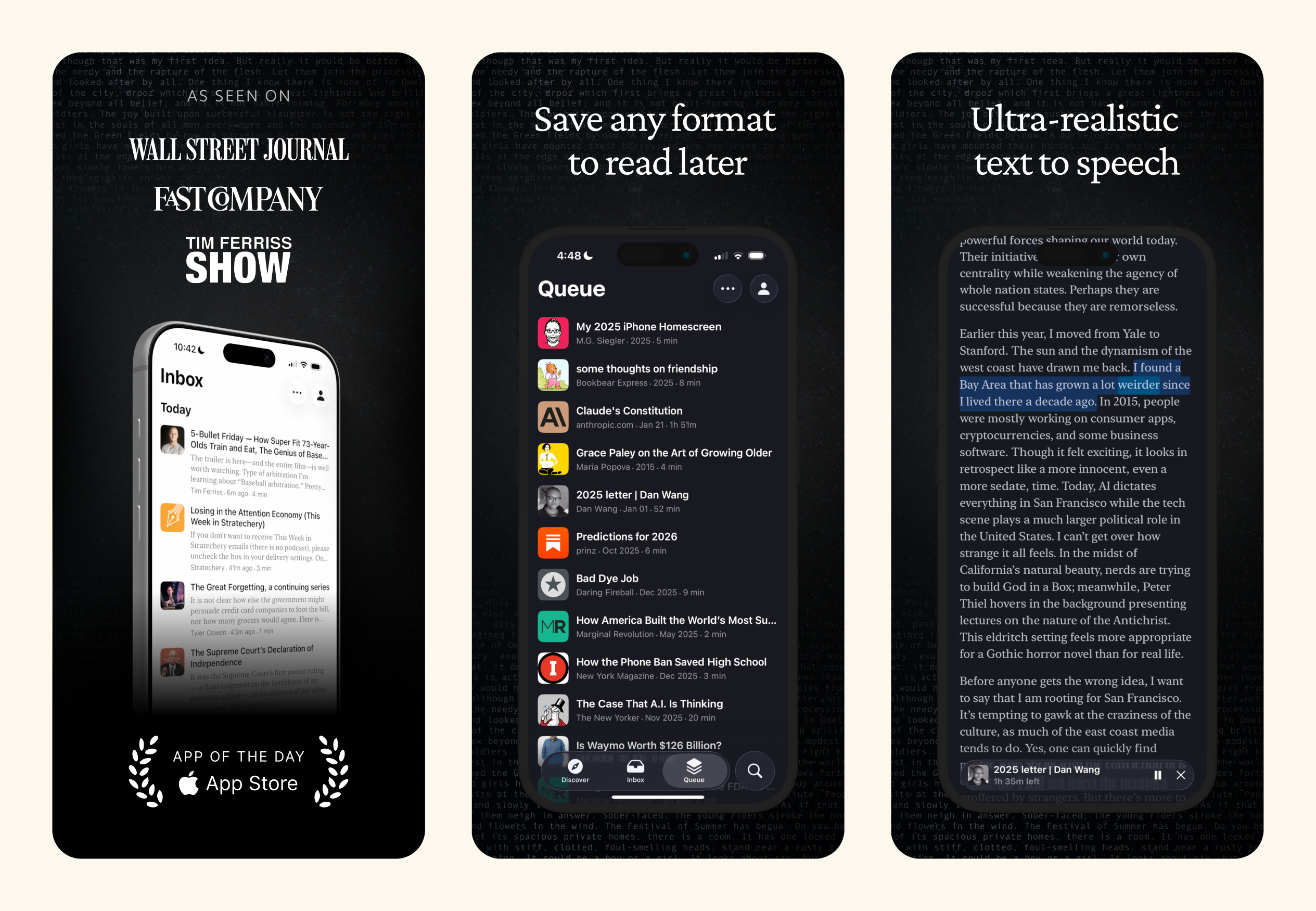
Matter is the modern read-later app for serious readers. Since Pocket shut down last fall, tens of thousands of readers have made Matter their new home.
Designed for Apple, Matter has earned multiple App of the Day honors and won MacStories’ 2025 Feature of the Year for its ultra-realistic text to speech. It’s been recommended by Tim Ferriss, Patrick Collison, the Acquired Podcast, and The Wall Street Journal, among others.