


Welcome to a new issue of Words That Matter! Each week, we invite a guest curator to share the reading that matters most to them.
Our curator today is Rohit Krishnan (@krishnanrohit). Rohit is CPO of Bodo and writes Strange Loop Canon, his Substack with 24,000+ subscribers, where he publishes deeply researched, playfully written essays on AI, organizations, talent, and the strange ways ideas compound across disciplines. He also wrote Building God: Demystifying AI for Decision Makers, a book that cuts through the hype to explain what AI actually is and where it's going.
Please enjoy these works and words that have mattered to Rohit!
Rohit’s Picks
Gödel Escher Bach
Douglas R. Hofstadter | 1979
This is the book that more than any other taught me what a nonfiction book could be! I read it first in college, and two decades later I still think about this book regularly. I named my blog after it. The use of self-reference and recursion as having deep commonalities across mathematics, music and art fundamentally changed my views in ways that aren’t easily describable, because I don’t know what before-me was like anymore. I still do not understand all of the book either, if I’m being frank, but that almost doesn’t matter. Once you read it, you cannot help but emerge changed.
The Glass Bead Game
Hermann Hesse | 1943
There are novels that discuss ideas, novels that discuss academia, and novels that discuss philosophy. Usually these are somewhat incompatible, or at least incongruous when you put it together. Hesse manages to do the impossible in this book. This is the best encapsulation of what it might mean to live in an ivory tower, to contemplate ideas and their interrelationships and find the beauty therein, that I’ve read. Herman Hesse is of course a master, which is why the very concept of this game, this eponymous game, that is barely described but you feel like you can just see it, it gets inside you and doesn’t let go easily.
Exit, Voice, and Loyalty
Albert Hirschman | 1970
I use this framework regularly to understand the world. More than any other I can think of, actually. Its simplicity is a virtue, because once you read it it’s hard to think of a world where this didn’t exist. When things get bad, people leave (Exit), or they try to change things (Voice), or stick around out of attachment (Loyalty). The balance between these describes a system. Any system. Every system! From politics to work to relationships. A seminal work.
Tlön, Uqbar, Orbis Tertius
Jorge Luis Borges | 1940
Borges is a highly rated, and still criminally underrated, author, whose work is even more important now in the age of LLMs. This is a canonical piece I read during a phase when I was jumping off of magical realism. I read it as a fugue. A blend of story, philosophy, and imagination. Here Uqbar is a forgotten land, which refers to Tlon. Tlon is the idealist world, an imaginary planet, governed by subjective idealism. There are no nouns, language is based on adjectives, and objects are brought into being through hope. (You can see where the post magical realism aspects fit). Which makes it a spectacular meditation on ideas-as-reality, and perhaps the best way I’ve found to think about the inner latent space inside LLMs.
The Sciences of the Artificial
Herbert Simon | 1969
A brilliant work by Herbert Simon. He makes a forceful case that manmade objects, artificial ones, can be studied with the same rigour as natural phenomena. I love it because it lightens the boundary between manmade and natural, and makes that membrane porous. It’s also the first glimpse into the world of complexity, later taken up by the likes of Santa Fe Institute, and makes this seemingly “soft” art, about design or understanding, into something harder.
The Use of Knowledge in Society
F. A. Hayek | 1945
Hayek’s book is required reading for anyone who wants to understand markets, or indeed the exceptionally complex world we inhabit. There are a large number of times when it feels like if only we had all the right information, if only we knew all the ways of doing something, we could figure out the right logical thing to do. But we can’t! The very importance of prices is that they embed all manner of local information that is combined, analysed, synthesised, and coalesced into a signal that we all know how to use. It’s distilled knowledge. It’s marvelous! And despite being the cornerstone of modern capitalism, somehow still underrrated.
Discworld (all of it)!
Terry Pratchett | 1983–2015
Okay, this is going to be hard to explain. On the surface, this is a series that’s about a fictional world that is flat (a disc), which has wizards and witches and vampires, extremely whimsical and silly and funny. Really really funny. But underneath, it contains some of the most astute observations about the human condition I’ve read. Vetinari, Weatherwax, and Vimes are some of the most fully formed, poignant, hilarious characters to be created in literature. And each of them, and many more, gets a full arc across multiple books.
Sir Terry deals with philosophy, technology transforming society, government systems, religion, everything that makes up life … Making Money itself would help a large number of economics commentators today. I have an enormous soft spot for those authors who can discuss complex themes but can still be funny. It’s perhaps that old notion about “Ginger Rogers did everything that Fred Astaire did. She just did it backward and in high heels”, but with literature.
The Culture Novels
Iain M Banks | 1987–2012
A weird part of living so close to talk about AGI is that it’s incredibly difficult to discuss what the future is going to be like without it sounding like magic or making it dystopian. Well, Banks has crafted the single best future world that is incomprehensibly large, logically coherent, insanely ambitious, and utopian, but with human-scale struggles, that I have ever read. I truly don’t grasp how he wrote these books. It is impossible to describe, because I don’t even think they are just novels. I read them like wikipedia entries about a weird future time that I am glimpsing through a somewhat foggy mirror. If literature is meant to expand one’s horizons and think better then there is nothing better for you to read. I recommend starting with Player of Games, as the most “normal” of these, or Excession. But go in any order you like, they will expand your world.
The Peripheral
William Gibson | 2014
Science fiction novels about the apocalypse or about the post apocalypse can get quite boring. Once you’ve read a couple, especially if you’ve seen a movie in the last few decades, the beats are quite predictable. Which is why I love this so much. William Gibson wrote the most fresh, original and interesting take on an apocalypse that I’ve read recently. It is both a page turner and it is exceptionally well thought out, a rare combination. It also works as a commentary on the present by presenting both the near future and the far future and also as a commentary on the development of technology. I walked around for a while after first reading it thinking damn, Gibson has solved science fiction, which is a weird sentence but you’ll see what I mean when you read it. It shuts down the genre. It’s also the one of the only real scifi novel of recent years that remains brilliant despite the advent of AI. There’s even a pretty good TV show.
How Life Works
Philip Ball | 2023
Most origin-of-life writing handwaves at “complexity”. As much as I’m a fan, I agree that it’s really difficult to get beyond the initial ‘wow’ and to actually learn what to do or what to predict with complex systems. And the most complex of these, beyond economies or companies, is biology. Philip Ball, who used to be the editor of Nature and has written some spectacular books, looks at this world here, and shows how incredibly complex biology actually is, across all scales.
He gives a brilliant and complex and frankly the best account I’ve read of how life came to be and why it works. And in doing so he shows what’s missing with the metaphors we use, where we think of DNA as a blueprint or biological systems as akin to mechanical devices. It’s therefore one of the best arguments against reductionism I’ve read, showing even single cells have “agency” of some sort, and it makes the case for the sheer internal complexity we’d have to confront were we to eventually reach human emulation in a non-biological substrate.
Anathem
Neal Stephenson | 2008
Neal Stephenson had to make the list, the only question was which book. I chose Anathem here in the end because it’s essentially worldbuilding as an argument. It’s (in my mind) a cousin of The Glass Bead Game, another monastery like community, where intellectuals are isolated and pursue their own interests. But while Knecht looks at the outside world through his friends, Stephenson brings in an extraterrestrial conflict. It’s difficult to describe, but is an everything-novel, where it deals with everything. What more could you ask for!
Spotlight on Rohit’s Work
I write essays that I would want to read, and as the lists above show my interests revolve around finding ways to understand things - which means it’s a combination of either new research or experiments I did or observations of the world that let me reframe my understanding somehow. A few examples I like:
What Would a World With AGI Look Like? — Works through the GPU, energy, and labor requirements of AGI and arrives at numbers that would demand rewiring the entire semiconductor and power industries. A useful antidote to hand-wavy AGI takes.
Life in India Is a Series of Bilateral Negotiations — A travelogue that turns into a Coase theorem explainer. Marvels at India’s infrastructure glow-up while diagnosing what still holds it back: a culture where every interaction — merging lanes, skipping a queue — is a one-on-one negotiation rather than a shared norm.
Seeing Like a Network — A theory of why everything feels broken. Network densification — not any particular platform or politician — is the root cause of polarization and institutional distrust. The flight to Discord and dumb phones is a healthy instinct toward sparser networks.
Will Money Still Exist in the Agentic Economy? — Turns the “Coasean singularity” thesis into a testable claim. LLM agents run through barter scenarios of increasing complexity don’t develop money organically — unlike humans, they never convert IOUs into a shared numeraire.
Hierarchical Growth Trade-Offs — On why large organizations calcify. Hierarchy is a rational response to information overload, and breaking it requires increasing communication bandwidth — not just flattening org charts.

Brought to you by…
Today’s issue is brought to you by Matter.
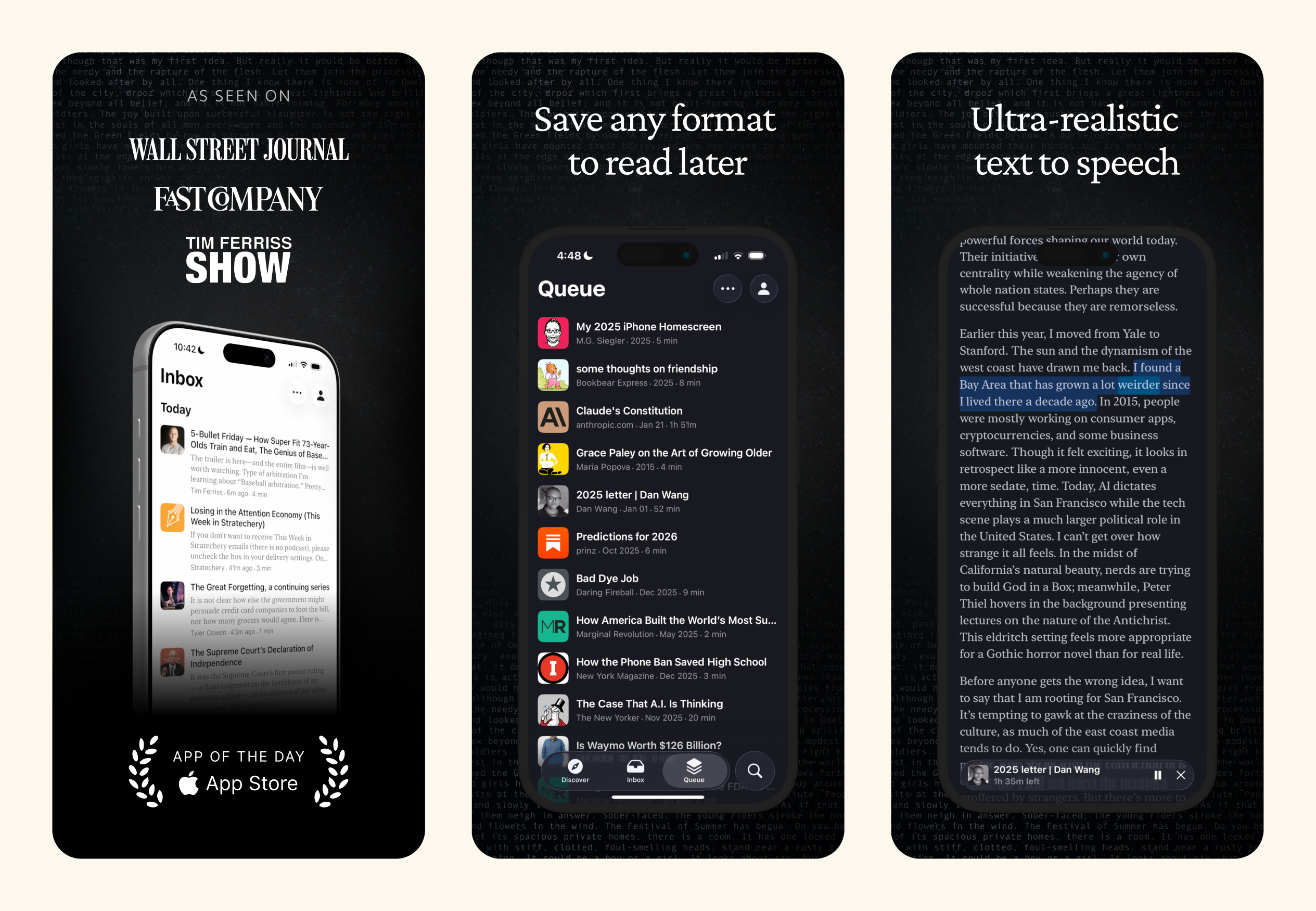
Matter is the modern read-later app for serious readers. Since Pocket shut down last fall, tens of thousands of readers have made Matter their new home.
Designed for Apple, Matter has earned multiple App of the Day honors and won MacStories' 2025 Feature of the Year for its ultra-realistic text to speech, which now supports 15 languages. It's been recommended by Tim Ferriss, Patrick Collison, the Acquired Podcast, and The Wall Street Journal, among others.
Interested in switching from Pocket or another read-later app? Matter is offering 50% off your first year — just email hello@getmatter.com to claim it.
Brilliant. A number of these books have been on my list for a while… time to prioritize them!Thanks for sharing, Rohit!
I love all of these!