


Welcome to a new issue of Words That Matter! Each week, we invite a guest curator to share the reading that matters most to them.
Nabeel S. Qureshi is an entrepreneur, writer, and engineer. He's currently the CEO of a stealth startup. Previously, he spent eight years at Palantir as a forward-deployed engineer and was a founding employee at GoCardless. He was a Visiting Scholar at the Mercatus Center, where he worked on AI policy alongside Tyler Cowen. He studied Philosophy, Politics, and Economics at Oxford. He writes at nabeelqu.co and Substack, and is @nabeelqu on X.
Please enjoy these works and words that have mattered to Nabeel!
Nabeel’s Picks
The Iliad, or the Poem of Force
Simone Weil | December 1940
A masterpiece of literary criticism. I read this essay before I read the Iliad, and it is what made me finally pick up the book. I don’t even fully agree with her arguments in here, but this is the bar of what high quality literary criticism really does, which is get you to understand a great work of art differently and appreciate it more.
Context Is That Which Is Scarce
Tyler Cowen | February 10, 2022
One of Tyler’s mantras I think about constantly, and more important than ever in the AI era. You must think of ‘context’ in the broadest possible sense here.
Shoulda Been Dead
Kevin Kelly / This American Life | January 17, 1997
I strongly recommend listening to this and not reading the transcript; Kevin Kelly narrates the story that led to his conversion to Christianity. Probably the most moving and beautiful short essay I’ve ever listened to.
Fake Thinking and Real Thinking
Joe Carlsmith | January 28, 2025
A great essay on the phenomenology of truth-seeking, plus a lot of tricks for actually getting yourself to seek after truth, very much in the rationalist tradition.
The Scaling Hypothesis
gwern | May 28, 2020
I was torn between this or Sutton’s “Bitter Lesson”, but if I were to tell somebody from the past the one key historical fact they needed to understand about the 2020s, it would be the one laid out in this essay.
Be Specific
Eliezer Yudkowsky | April 3, 2012
One of the most important cognitive skills. This essay in particular captures what I like so much about the rationalist movement – the earnest attempt at understanding the truth.
The Lives of Animals (Tanner Lecture)
JM Coetzee | October 15, 1997
A beautiful example of philosophical fiction, a provocative lecture, and also a great example of how art and morals can intersect.
Spotlight on Nabeel’s Work
A few things I’ve written that people seem to like:
How To Understand Things — On intelligence as a virtue rather than a fixed trait. The smartest people I know aren’t necessarily the fastest thinkers; they’re the ones who refuse to accept answers they don’t actually understand.
Reflections on Palantir — After eight years, I tried to explain what the company actually is and why it produces so many founders. This got more attention than I expected.
On Reading Proust — Why In Search of Lost Time is now my favorite novel, and why it’s not as intimidating as it seems.
Principles — A running list of things I try to keep in mind. “Doing as much as you can every day is a form of life extension.”
I was also recently a guest on Dialectic, a podcast with Jackson Dahl.
Brought to you by…
Today’s issue is brought to you by Matter.
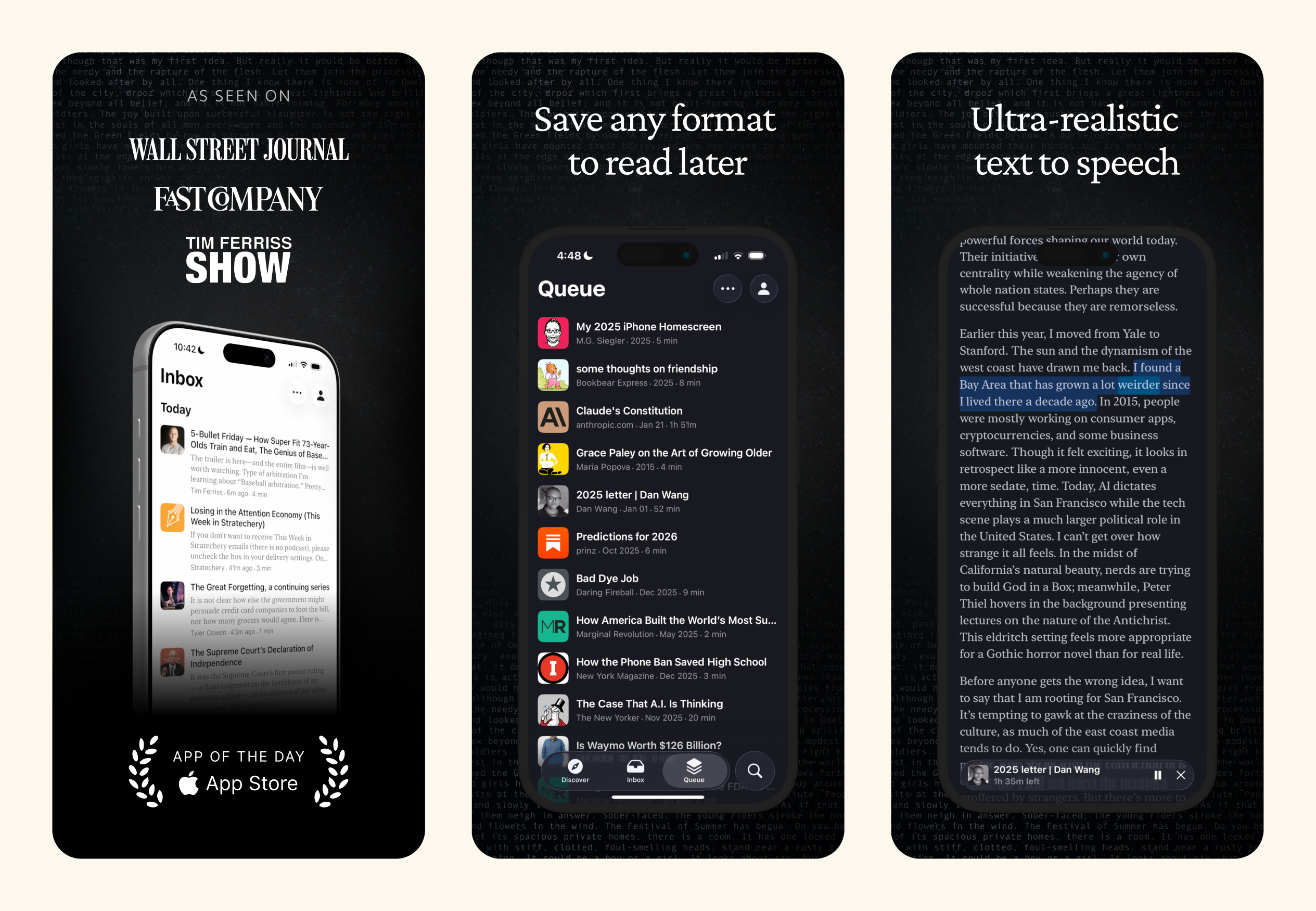
Matter is the modern read-later app for serious readers. Since Pocket shut down last fall, tens of thousands of readers have made Matter their new home.
Designed for Apple, Matter has earned multiple App of the Day honors and won MacStories’ 2025 Feature of the Year for its ultra-realistic text to speech, which now supports 15 languages. It’s been recommended by Tim Ferriss, Patrick Collison, the Acquired Podcast, and The Wall Street Journal, among others.

There are no specifics in all of text. Text is by nature arbitrary. For specifics you need spatial or neural syntax, both analogs.
Forget literacy, it was models and toy thinking. Think next.