


Welcome to a new issue of Words That Matter! Each week, we invite a guest curator to share the reading that matters most to them.
Celine Nguyen (@mynameisceline) is a writer, software designer, and literary critic. She writes personal canon, a newsletter about literature, design, art, and technology. Her essays have also appeared in Asterisk, The Atlantic, the LA Review of Books, and Empty Set. She is especially interested in how people develop taste, attention, and a serious relationship to art outside formal institutions.
Please enjoy these works and words that have mattered to Celine!
Celine’s Picks
The Center and the Periphery
@Afra Wang ✴︎ April 2026 ✴︎ The Ideas Letter
About ten minutes after meeting Afra Wang—at a friend’s party in London—I found myself discussing all the big questions with her. What’s the difference between Chinese and American techno-optimism? Do we think the world is getting worse or better? I quickly realized that Afra had something insightful to say about nearly everything, from AI policy to literary fiction. I’ve been following her work ever since.
When Matter first asked me to curate an issue, I couldn’t decide which piece of hers to include. I loved Afra’s article for Wired (where she wrote about The Morning Star of Lingao/临高启明, a collectively-authored sci-fi novel published on the Chinese internet); and I return often to her essay for Asterisk (about the Chinese tech canon and what founders read to learn from, and compete with, Silicon Valley).
But my favorite piece of hers might be this essay for The Ideas Letter, where she writes about growing up in China and how students learned to jailbreak their Apple products:
The summer I started high school in Shanxi, I learned that the world had a new texture. It was the early 2010s and I held in my hand for the first time an iPod Touch. I still remember dragging the unlock bar across the screen. The gesture was new—the whole paradigm of touch was new—and the device responded with a light, precise click, a sound as clean as some cosmic voice. I was holding a piece of the future in my hand, and the future had been designed somewhere else.
It’s a beautiful personal essay on the emotional, intuitive relationship we have with technology. It’s also a fascinating look at how experimentation and imitation—studying another company’s products closely, let’s say—can help entrepreneurs come up with new innovations.
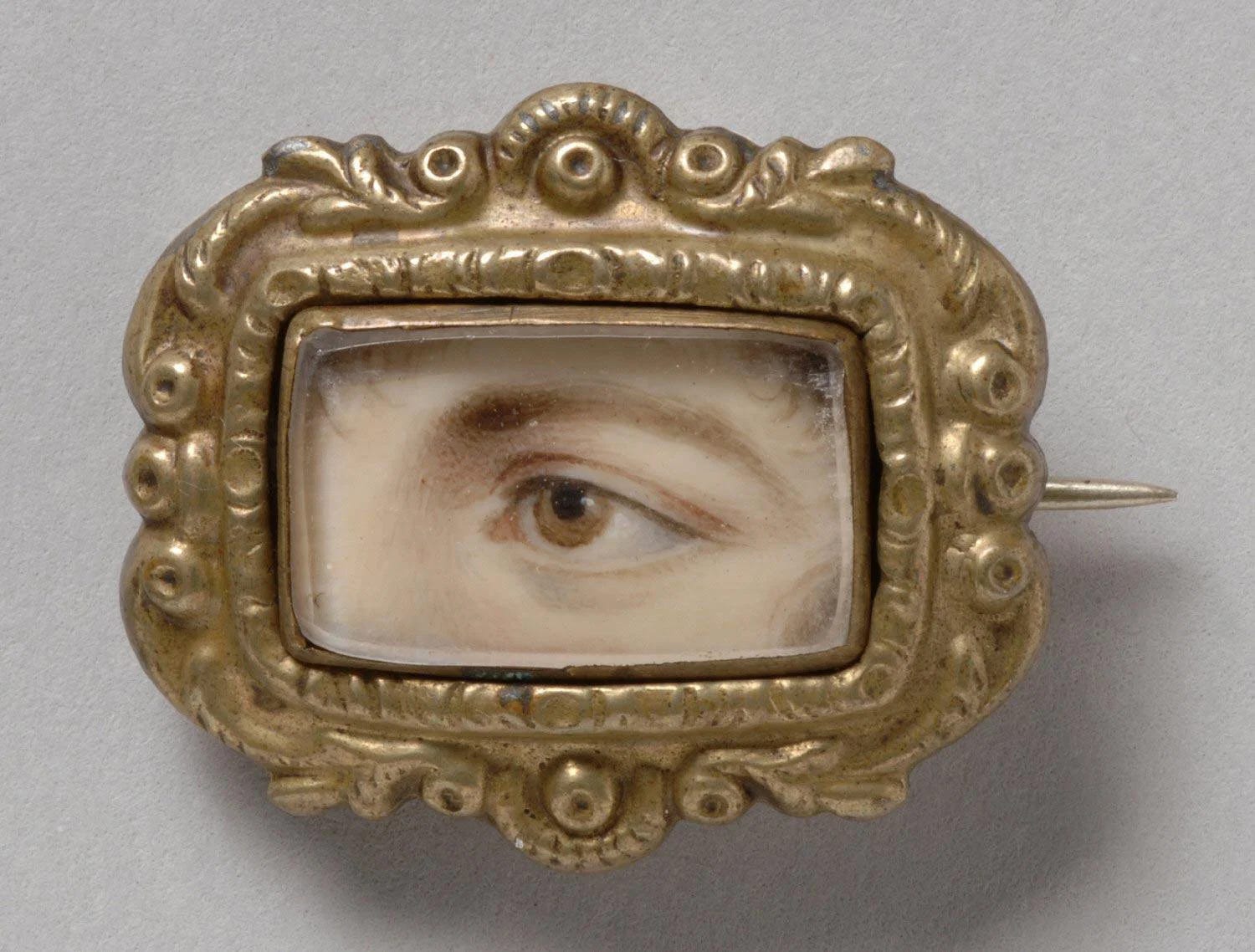
All Good Sex is Body Horror
@Becca Rothfeld ✴︎ February 2024 ✴︎ Book excerpt in the New Yorker
A few evenings ago, a friend and I were discussing the essays we admired most, and Rothfeld’s “All Good Sex is Body Horror” came up. We were able to remember specific moments: how the essay began, how Rothfeld brought in specific ideas and philosophers—even though it had been months, years even, since we’d read it.
It’s in Rothfeld’s All Things Are Too Small: Essays in Praise of Excess, which could be described a bit blandly as a book of literary criticism, but which I’d like to describe—a little more idiosyncratically, and perhaps more accurately—as a book about how to live a fuller life, with generous attention paid to the books and films and philosophies that shape our world. Similarly, “All Good Sex is Body Horror” could be described as an essay about David Cronenberg’s films, but it’s also about sexuality, love, and desire.
How Rothfeld gets from a description of David Cronenfeld’s The Fly—a body-horror film about a man turning into a fly—to sexuality is a little mysterious. As in: it feels so entirely natural when Rothfeld’s writing makes that leap, but most people wouldn’t be able to connect these topics so beautifully. But here’s how Rothfeld does it:
Most people would give anything to be turned into anything else, because most sex is mediocre, and the measure of its mediocrity is that it leaves us unaffected. No one falls ill; no one transforms into a fly or a cockroach; nothing changes…No one has transformative sex all the time, and there is nothing wrong with sex that is merely pleasant…
Of course, many mediocre sexual encounters are rote in a more pernicious way…To have sex erotically—and ethically—is to have it with someone else, and a person demonstrates her difference from the self by being impossible to predict, domesticate, or assimilate to preëxistent fantasy…Eroticism occurs only when someone rewrites us so completely that she rewrites even the quality and content of our appetites, and only when this radical rewriting is reciprocal.
The Norway Model
Ida Lødemel Tvedt ✴︎ November 2023 ✴︎ The Dial
One of the more harmless national stereotypes I hold is that Norwegians are profoundly well-read. (According to the Finns I surveyed at a wedding last summer, they’re also supposed to be very outdoorsy—but that’s less relevant to this newsletter.) This belief stems from the outsized role that Norwegian literature plays in the literary world: There’s Jon Fosse, who won the Nobel Prize in Literature in 2023; but also Karl Ove Knausgaard, Dag Solstad, and Vigdis Hjorth (required reading for Sheila Heti fans).
But Norway is a country of less than 6 million people. And why do I know so much about the literature of a country I’ve never been to? Tvedt’s essay tries to answer this, and in the process reveals how literature written in one language makes its way to another. It’s a great read if you’re a fan of literature in translation; it’s also a great read if you just want to be entertained:
Karl Ove Knausgård, Dag Solstad and Jon Fosse — the three most internationally acclaimed Norwegian writers alive — all have personas that fit with foreign imaginations of “the north”…All three have a hermit vibe, eyes lit with dreams of God or Marx. They all seem not to want the public’s eye on them, and yet to really want it, in a manner that works for some kinds of personalities but might seem too coy and self-conscious for others to pull off. Somewhere in my notes I have quoted the American critic James Wood calling them “Norwegian literature’s Little Brain, Big Brain and Galactic Brain,” but I can’t find the citation anywhere and thus suspect I have made it up. Are these long-haired neurotics Great Writers, or are they 1) really good-looking (Knausgård), 2) really good at writing opening scenes and caricaturing his contemporaries (Solstad) and 3) gnostic and icy and unapologetically boring (Fosse)? Will these authors hold up a hundred years from now? I think they might, but for now, who knows. I profoundly love books by all of them, but regarding their Greatness, the jury is out. It is like asking: Are French New Wave films good, or do they just have really nice eyeliner?
And it’s worth noting that the magazine this is published in, The Dial, is—in my opinion—one of the best places to read investigative journalism and literary fiction from around the world. One game I like to play, whenever I’m added to a new groupchat, is to request rankings of the best magazines being published today. I always list The Dial as an S-tier magazine; no one has disagreed with me yet.
How I Became a Filmmaker
Lena Dunham ✴︎ March 2026 ✴︎ Memoir excerpt in the New Yorker
There’s a particular coming-of-age, Portrait of the Artist as a Young Man/Woman/They/Them–style essay that I’m always looking for. It’s about someone who’s already famous and beloved for their work; it’s about the years before that point, when they were grinding it out in obscurity, trying to not give up.
That’s what this essay is about: Lena Dunham, age 20, making her first short film:
I called it a satire, although I’m not sure I even knew what that meant…It’s that kind of hubris that defines being a young artist, and it should never be beaten out of anyone.
I think what I’m looking for, in these stories, is the recipe for success. Or just the recipe for endurance. Because I’d like to do something good someday, or even great; but how do you make it there, when you don’t know what you’re doing and you’re not sure why anyone cares?
Dunham’s essay, which is excerpted from her new-ish memoir Famesick, offers some clues. You find your peers: Josh and Benny Safdie, in her case, whose short screened right after hers at an indie film festival. And you should befriend them:
All I had wanted was to be around people who were making movies—not just talking about movies, or writing about movies on their Blogspots, like the one on which I reviewed Cassavetes films for no one, but actually making them. And now here they were.
The Limits of Data
C. Thi Nguyen ✴︎ 2024 ✴︎ Issues in Science and Technology
Here’s another essay I return to all the time, partly because it’s written by a philosopher whose work touches on all the things I care about: art, technology, information, play. Nguyen (no relation, although I’d love to meet him someday) is a food writer turned philosophy professor, and even his academic writing—like Games: Agency as Art, published by Oxford University Press in 2020—is effortlessly enjoyable to read.
One of the reasons I love Nguyen’s writing is that he is equally concerned with the ineffable and intuitive aspects of life—aesthetic experience, in particular, but also ethics, generosity, community—and the more quantitative parts. This essay is about what we seek from data, and why it’s hard to get it:
I once sat in a room with a bunch of machine learning folks who were developing creative artificial intelligence to make “good art.” I asked one researcher about the training data. How did they choose to operationalize “good art”? Their reply: they used Netflix data about engagement hours.
The problem is that engagement hours are not the same as good art. There are so many ways that art can be important for us. It can move us, it can teach us, it can shake us to the core. But those qualities aren’t necessarily measured by engagement hours…I said all this. They responded: show me a large dataset with a better operationalization of “good art,” we’ll use it. And this is the core problem, because it’s very unlikely that there will ever be any such dataset.
Now that I’m returning to “The Limits of Data” in 2026, I’m realizing that half of the people I admire are unwaveringly opposed to the idea of AI making art; the other half are busy trying to make it happen. But I think both camps, however much they distrust each other, can find something thought-provoking in Nguyen’s essay. Nguyen elegantly explains why large datasets are valuable and all the forms of knowledge they create. But he also points out the forms of knowledge that can never quite be achieved at scale. “My point,” he writes,
isn’t that we should stop using data-based methods entirely. The key features of data-based methodologies—decontextualization, standardization, and impersonality—are precisely what permit the aggregation of vast datasets and are crucial to reap the many rewards of data-based methodologies…
It’s not like qualitative methods are perfect; every qualitative method opens the door to other kinds of bias. Narrative methods open the door to personal biases. Trusting local, sensitive experts can open the door to corruption. The point is that data-based methodologies also have their own intrinsic biases. There is no single dependable, perfect way to understand or analyze the world.
On Giving Up
Adam Phillips ✴︎ January 2022 ✴︎ London Review of Books
I often come across advice about how it’s okay to fail: to ask for something you might not get, to approach a stranger who might rebuff you, to ship a feature that fails to get meaningful usage, to try out a business idea that fails, to publish something that no one reads.
But if failure is okay, and experiencing it is encouraged, what happens after the failure? Do we keep on going? Do we stop?
The British psychoanalyst Adam Phillips has a whole book on this subject, but I prefer the shorter (relatively speaking: it’s still 6,000 words) essay that inspired it. “We tend to think of giving up,” the psychoanalyst Adam Phillips writes,
as a lack of courage, as an improper or embarrassing orientation towards what is shameful and fearful. That is to say we tend to value, and even idealise, the idea of seeing things through, of finishing things rather than abandoning them. Giving up has to be justified in a way that completion does not; giving up doesn’t usually make us proud of ourselves; it is a falling short of our preferred selves…Giving up, in other words, is usually thought of as a failure rather than a way of succeeding at something else.
Phillips is interested in the positive aspects of giving up. You might be living a life that you don’t really want to live; you might be clinging on to certain assumptions, limiting beliefs, fears. The essay makes use of a wide range of literary references—Kafka, Shakespeare, Camus—to suggest that giving up, sometimes, is good for you. It lets you live a different life, and maybe a better one.
Phillips’s writing can be enigmatic and elliptically repetitive—I’m doing the same thing, in writing about him—but he reaches into the inner workings of the psyche like no other writer I know. This is an essay for when you’re feeling a bit burdened by existence and you don’t know where to go next.
Spotlight on Celine’s work
You can follow Celine on Substack at @celinenguyen and subscribe to her newsletter, personal canon. Her most popular newsletter is research as leisure activity (here’s the Hacker News discussion about it!). If you want a deep cut, try this 10,000-word newsletter on what AI art can learn from Fluxus artists like John Cage, Yoko Ono, and Nam June Paik.
She also writes about design, technology, and art for other publications:
“Is the Internet Making Culture Worse?” for Asterisk
“The Perils of ‘Design Thinking’” for The Atlantic
“Seeing Like a Simulation” for the LA Review of Books
“The Afterlives of Computer Art” for Empty Set
And if you’re a podcast person:
Brought to you by…
Today’s issue is brought to you by Matter.
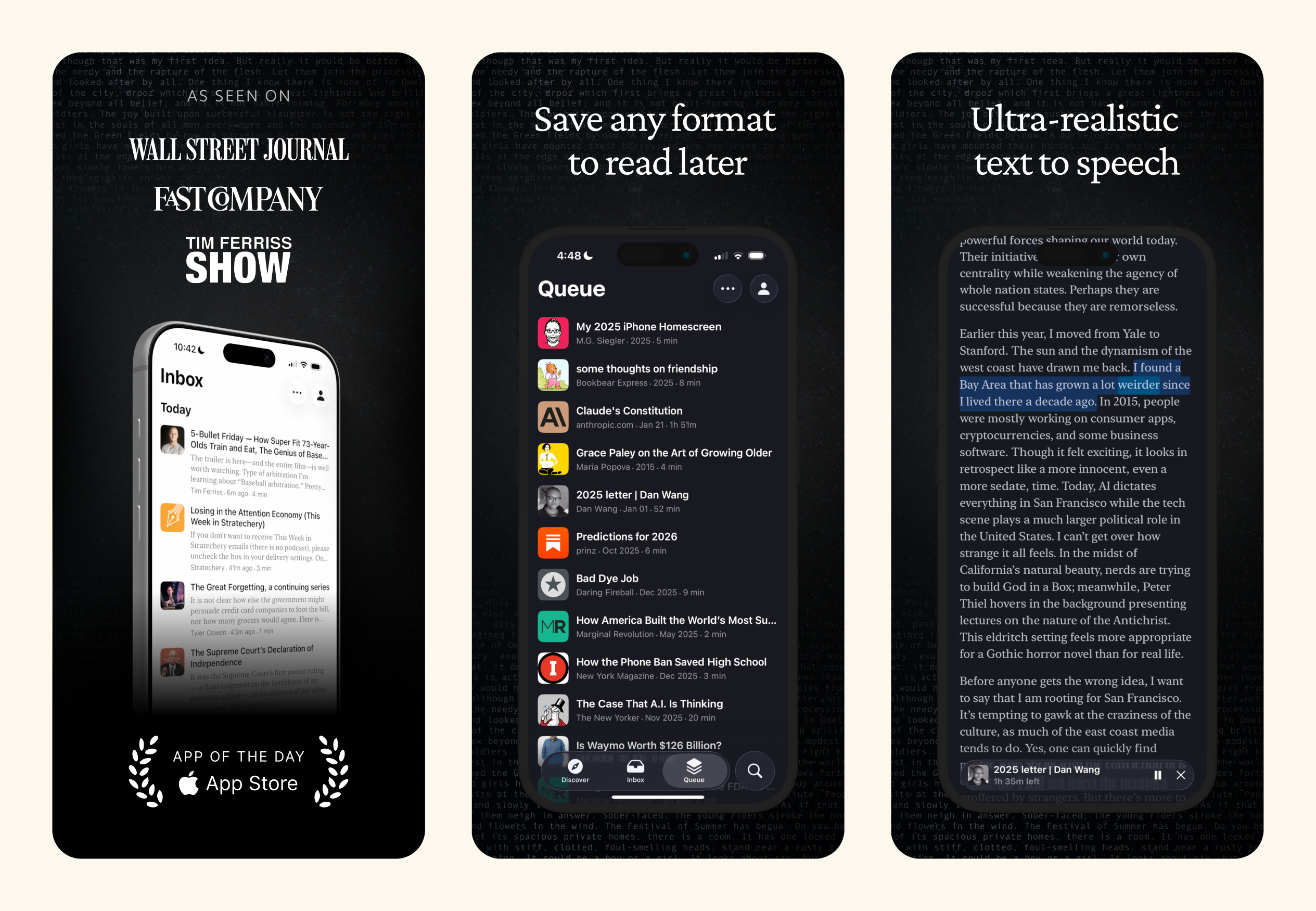
Matter is the modern read-later app for serious readers. Since Pocket shut down last fall, tens of thousands of readers have made Matter their new home.
Designed for Apple, Matter has earned multiple App of the Day honors and won MacStories’ 2025 Feature of the Year for its ultra-realistic text to speech. It’s been recommended by Tim Ferriss, Patrick Collison, the Acquired Podcast, and The Wall Street Journal, among others.
The nuance and consideration in these recommendations is incredible. Thank you for sharing, Celine!
Celine is one of my favourite writers here on Substack. We may not share the same taste in books, but her article recommendations are always immaculate. And also the way she spotlights artists and works on her notes. Can’t wait to read the Nguyen essay 💗💗💗