Welcome to a new issue of Words That Matter! Each week, we invite a guest curator to share the reading that matters most to them.
Our curator this week is Anna Gát (@TheAnnaGat). Anna is the founder and CEO of Interintellect, a platform reviving French salon culture for the digital age. Since 2019, Interintellect has hosted tens of thousands of depolarized conversations online and offline—from grand salons with Esther Perel, Daron Acemoglu, or Tyler Cowen to intimate firesides among curious strangers. Anna trained as a philosopher of art and dramaturg, published her first book of poetry at 19, and was nominated for European film awards as a screenwriter, before turning to dialogue technology. She writes the Substack American Innocence.
Please enjoy these works and words that have mattered to Anna!
Anna’s Picks
To think originally, one needs to read originally. In my new essay “The Sovereign Reader” I wrote: “The more unique and personalized the books you read, the more original a thinker you will become. This, in short, is how you become you. I am a strong post-Hegelian believer in the personal duty of coming into our full being throughout our lives. Other than finding a fitting occupation and worthy life companions, cultivating your own mind is the prerequisite for building an existence for yourself that is truly yours.”
“bye, mom”
It has long been my view that one of the best writers alive today is the escort and sex researcher Aella. Whether she writes about intimacy, her upbringing in an abusive Evangelical home that she later fled, psychedelics, or how status works in society, she is insightful, honest, poetic, and often right.
Even among her many great pieces, this one hits differently. Aella, more conscious of her internal processes and better at verbalizing them than almost anybody that I read, cares for her dying mother, sees her die, and then mourns her. Having recently lost a parent in a similar way myself, I was struck by the fragile accuracy, the complete, membrane-like transparency of this daughter’s account. A fearless, rare gem of a text, forged the hard way.
I know from several Aella pieces that their relationship was not easy. To write such a tribute is a glorious act of forgiveness and intellect for that reason alone.
Plato’s Cave at the Drive-in Theater
The NYU cultural historian Robles-Anderson is concerned with “American collectivity”. We are being constantly told that this is the “age of loneliness”, that people have lost touch with their rituals of togetherness, their shared identities.
Robles-Anderson disagrees. In her work, the many functioning arenas of collectivity in American life take legible shape. The basketball court, the megachurch, the drive-in theater.
It seems like Americans have always been coming together, and always contrasted their private and public realities in spaces that are public or semi-public.
The Impossible Patient
Amia Srinivasan
I have been fascinated by Srinivasan, an Oxford philosopher, since her work on philosophical genealogy (which ideas lead to which other ideas). I mentioned her in my first recommendation list for Matter. I am including her again because I have long been convinced that “Freud is back”. And now it seems like excellent theoreticians like Srinivasan or Merve Emre also agree.
It remains to be seen whether going into therapy is really that beneficial after all. I have my doubts. But Freud having been groundbreaking is unquestionable: he created a paradigm shift in how we understand ourselves and each other at a level previously reserved for people like Darwin. We have never recovered.
Where do irrational ideas and behaviors come from? You might approach this question from a direction familiar to Bay Area rationalists or the New Atheists. Or you might want to go and revisit Dr. Freud.
On the Genius of Frances Burney, Jane Austen's Most Important Literary Predecessor
A. Natasha Joukovsky
Every person interested in “scenius” – the idea that talent isn’t really individual, rather something that arises from camaraderie and competition, i.e., group dynamic – must read this revisionist piece by the novelist A. Natasha Joukovsky.
Why do we keep portraying Jane Austen, a literary history changing writer and innovator of prose, as if she had popped out of the woodwork without any precedent whatsoever?
In her essay, Joukovsky argues that this was far from the case. There is always an ancestor to genius, and in this case it was Frances Burney. Have you heard of her? Now you will. Jane Austen certainly had.
(In all fairness, the erasure was not Austen’s fault. It is hard for a woman to occupy a literary position, etc., etc., and so the other women “had” to be removed from around her, it seems.)
All Good Sex Is Body Horror
One of my absolute favorite readings from the past years. Rothfeld, a generational essayist, since then hired up by the New Yorker, writes about the mad artistry of the body horror director David Cronenberg – the transgression, the carnality of his movies – through the prism of her own lustful marriage. What Michel Foucault would have called “limit-experiences”, Rothfeld describes her own sensual awakening when first meeting her now-husband, and the boundary-crossing that is inherent to any such event.
She sees the director of Crash and The Fly as uniquely honest at describing an experience fundamental to human existence: that love and a desire for destruction are somehow one, that pleasure and disgust can both save us from triviality; that any real encounter is a physical metamorphosis after which nothing can remain the same. Not even us.
Rothfeld goes far beyond a simple review of Cronenberg’s works. To her, contemporary notions of “consent” feel meaningless. It is not to comfort that real eroticism consents to, she says, but risk. Some artists, like Cronenberg, understand this urge for transformation.
50 Things I Know
In a sea of mediocre, navel-gazing self-help writing, the courageous, complicated, and athletic Cate Hall has been a consolation. Like everyone else, I also do need advice literature, and being able to engage with such a smart, raw, and out-of-the-box writer has been a pleasure. Whenever I read Hall, I think: “Finally.”
Hall is best known for her writing on agency, love, and addiction. She is currently about to publish a book with her husband Sasha Chapin. She has led an unorthodox life.
What I love about her piece “50 Things I Know” is that even where I don’t agree with her, I can be sure her advice comes from a place of real experience. Hall, without any hidden agenda, is sharing the truths and strategies that have kept her going. A useful and uplifting read about work, happiness, talent, and people.
A British Nurse Was Found Guilty of Killing Seven Babies. Did She Do It?
Wherever you stand on the infamous Lucy Letby case – A raging psycho? A failure of the British judiciary system? – Aviv’s arresting investigation will give you something to think about.
When a crime as horrific as the possible murder of multiple newborn babies occurs, people, already unstable in their judgment and biases, become almost blind to the facts, mere vehicles of motivated reasoning.
In this case, gaping flaws in statistical methodology are contrasted with the conventional wisdom of decades of practical experience. How to know what really happened? Do you believe the science or your own eyes?
I left Aviv’s exceptional article with a darker view of human nature. Not just because of how our fellow citizens may harbor criminal inclinations, but that we, the rest, the good, are so bad at reasoning about it.
The Great Leap Backward
Lea Ypi – the celebrated political memoirist of Free – has become a symbol of intellectual resistance and survival. The Romanian medievalist, poet, and literary critic Dumitrescu reads her otherwise.
Critics of Free take issue with Ypi’s equating of Communist oppression (in her native Albania) and capitalist inequality (in her family’s chosen new life in the West). Dumitrescu’s skepticism runs deeper: she suspects this autobiography to be even more autobiographical than it seems. She thinks that while Ypi does attempt to write about politics, what she really ends up writing about is her belligerent relationship with her mother. Imagine that.
This is one of my favorite recent book reviews: I keep thinking whether any memoir can ever be – if not objective – then at least self-aware. Dumitrescu doesn’t think so.
Against Nature
Jane Kramer
As a European art philosopher turned media startup founder living in America, I find it hilarious that American and French philosophers don’t understand each other at all. You can go to conferences, and observe people who are giants within their own cultural contexts, surrounded by kowtowing students and wannabe groupies at all times – they are the intellectual celebrities who just cough and everyone starts taking notes – and whose status means absolutely nothing when they’re dropped into each other’s worlds, their fame and value being mutually illegible.
A great example of this is the brilliant French philosopher Élisabeth Badinter, a paradigm-shifting feminist in her native France and close to nobody in the United States of America. She, as Kramer quotes her, now won’t even visit America because she can’t smoke here (and because of a humiliating exchange she was subjected to at Princeton).
On a mission to ground feminism on Enlightenment values, Badinter today counts as an interesting controversy within French academia, older, unfashionably elite, but knowledgeable and disciplined. But her work – her words – just doesn’t translate to the American language of discourse.
I love Kramer’s ambivalence in this piece which always makes me ponder about how siloed most intellectual effort is, and how relative and circumstantial is status.
As Long as You Both Shall Live
Merve Emre
“This is the obvious yet shocking revelation that anchors the film: every parent’s marriage plot is her child’s Bildung.” – this is the sentence that stayed with me for the past couple of years from Emre’s review of the formidable movie Anatomy of a Fall.
It is, of course, about much more than just a movie. What Emre probes is the ability of women to tell the story of women in a way that resonates with everyone and in a way that is not so unflatteringly true that women themselves would resist admitting the resonance.
I remember reading this review first, and only being able to watch Anatomy of a Fall sometime later. Emre is far more interested in the narratives of private life than spoiling the movie for us. Is every family just a matter of perspective? Do “canonical” realities exist between people who share their lives?
Good art criticism should always be somehow about all of life. I remember this review fondly because it so well succeeds.
The Instrumentalist
Zadie Smith
The great British GenX novelist and literary critic Zadie Smith uses the controversial 2022 movie Tár as a starting point to explore fame and public intellectuals in the internet era.
The essay scandalized many because here is a Black literary genius in the post Me Too era going at a movie about a cancellation from a completely different angle.
One of the most interesting ideas in this essay, about which I think often, is that the internet has killed the ad hominem. In classical rhetorics, it used to be a no-no fallacy to dismiss a claim because of who said it. Smith claims that on the internet such distinctions would be ridiculous. Online we are our opinions – one entity, indivisible. Where do ideas end and where do people who think them begin? Smith finds the fundamental problem with all of cancel culture in this unprecedented logical puzzle.
After Habermas
Nancy Fraser
A few weeks ago, the great German postwar philosopher Jürgen Habermas passed away at nearly 100 years old. Obituaries and essays are still pouring in from philosophers and sociologists, and people eager to point out that Palantir CEO Alex Karp wrote his PhD about him.
It is important to get acquainted with Habermas without either the praise or the malice. In this piece, the American Marxist-feminist philosopher Nancy Fraser eulogizes Habermas in a matter-of-fact and balanced way. Habermas started out as her mentor, someone she was drawn to as a thinker because he treated culture as a separate domain within society, as an area of liberation. Eventually, writes Fraser, she had to leave Habermas behind, only to later reconnect with him.
Fraser’s politics are not mine, but there should be more frank and personal commemorations written like this one. For someone like Fraser, committed to debate above all else, this is a way to give us a much-needed lesson in integrity.
Spotlight on Anna’s Work
A few pieces of note from Anna’s work:
You can subscribe to her Substack here and Twitter here.
Brought to you by…
Today’s issue is brought to you by Matter.
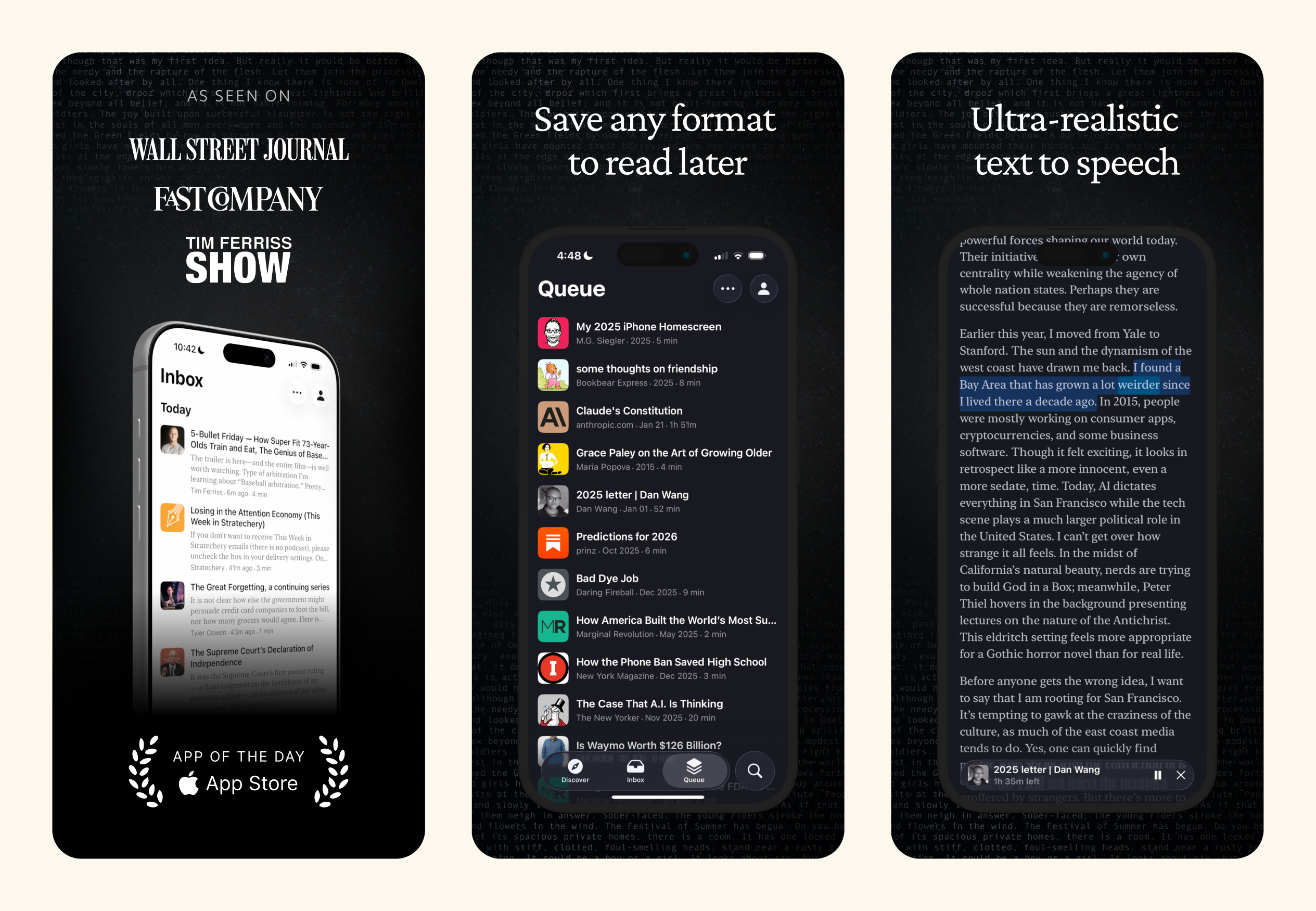
Matter is the modern read-later app for serious readers. Since Pocket shut down last fall, tens of thousands of readers have made Matter their new home.
Designed for Apple, Matter has earned multiple App of the Day honors and won MacStories’ 2025 Feature of the Year for its ultra-realistic text to speech. It’s been recommended by Tim Ferriss, Patrick Collison, the Acquired Podcast, and The Wall Street Journal, among others.