


Welcome to a new issue of Words That Matter! Each week, we invite a guest curator to share the reading that matters most to them.
Afra Wang (@afrawang) is a writer covering technology, China, and Silicon Valley, with a focus on the US–China AI rivalry. She writes the Substack Concurrent, hosts the podcast CyberPink, and has been a fellow at GovAI and The Roots of Progress Institute. Her work has appeared in WIRED, the Los Angeles Review of Books, and Asterisk.
Please enjoy these works and words that have mattered to Afra!
Afra’s Picks
There’s something endearing about being asked to curate this “words that matter” issue: the name of this very newsletter echoes my favorite essay collection, Ursula Le Guin’s Words Are My Matter. It’s a 300-page book full of wisdom worn lightly — and humor, and honesty, and bravery. An anthology of essays, book reviews, and diary entries (I’ve recommended it to everyone around me non-stop for five years now, and I’m still surprised and delighted each time I turn a page). I carry it everywhere and treat it as a kind of low-calorie holy bible (?). When the bigger questions lodge in my mind — what is a woman? what is language? what is a story? what is the life like when a female intellectual raise three kids, keep the house clean, utter many words all day long, and keep a sane relationship with her partner — all at the same time? — this is where I find answers.
Ok, let’s start.
Ken Liu on AI and Freedom
Jordan Schneider, Irene Zhang, and Phoebe Chow | May 2026 | ChinaTalk
Ken Liu’s take on technology and on the tech industry at large is something I never let myself miss. He’s not the literary figure a Silicon Valley tech bro conjures up and resents: the Bostonian fiction writer who hangs out in literary circles and would object to a data center’s water usage. As one of the most acclaimed sci-fi writers, Ken is often optimistic about tech, and comfortably adjacent to the industry. Here is a great interview he did with ChinaTalk (shoutout to Jordan and Irene), an episode I plan to listen to a few more times… Ken believes technology is, by nature, deeply humanistic — an extension and expression of human beings. I found all of the following passages quite romantic:
All of my fiction — whatever the marketing genre — is fundamentally technological. Whether it’s the Dandelion Dynasty, my short fiction, or the Julia Z series, they’re all stories about what it means for humans to express parts of themselves through technology.
If there’s something unique about humans compared to other species, it’s fundamentally our technological nature. This is important. A lot of things described as “sci-fi” aren’t really sci-fi at all — they have very little to do with science. They’re technological stories.
We are the only species who express who we are through the things we make. We imagine things that did not exist in the universe, then actually bring them into being — concretely substantiating our mental constructs in the world. And these technological manifestations, this stuff we ooze out, in turn changes who we are. We converse with, interact with, and co-evolve with our own creations. No other species does this.
The reason technology is so expressive of human nature is that it’s a manifestation of our deepest desires and dreams. We’ve always used mythology to express and understand technology.
YES THAT’S WHY I LOVE TECH AND SCIFI! And I love that, here, he implies technology is “a manifestation of our imagination” (very Le Guin-coded), that it’s expressive, linked to our irrational minds, our dreams, our intangible mental states. I also love that Ken insists “technology,” as a term, doesn’t refer to big corporations but to what Lewis Mumford would call “democratic technics”. Anyways, it’s a thoughtful and poetic and timely discussion (don’t miss the AI slop part!), and Ken convinced me tech is romantic and sublime and I shall write more about it.
Content Violation
Xiaowei Wang | June 2026 | The Ideas Letter
This one was written as part of a terrific “Reflections on the Machine” issue from the Ideas Letter, stewarded by LuHan Gabel. Among the five essays in the issue, Xiaowei Wang’s is the most provocative, and I couldn’t stop thinking about it.
Wang writes about a notorious banned film — Pier Paolo Pasolini’s Salò, or the 120 Days of Sodom (1975). When I Googled it, the first line of its IMDb page says “be prepared for one of the roughest films you’ll ever see.” In the piece, she takes up Pasolini’s own term, “false permissiveness”: the illusion of freedom and tolerance in modern consumerist societies that in fact masks a deeply entrenched conformity. Today’s generative AI, she argues, offers such false permissiveness. We’re fed an abundance of overfitted, mid-curve content (or slop); AI alignment and tech governance freeze “status quo ethics into computing,” which Pasolini would have seen as a “conformist flattening of the world.” Wang confesses, at the end:
If it is possible to love such a perverse, unimaginable, unwatchable film, I do love Salò. In an age of GenAI, Salò reminds us that art is a process rather than a commodity, a ritual that brutalizes and transforms. In the end, when we realize that we have not just witnessed, but have been transformed by, watching torture through the eyes of the four fascists, through the medium of film, we have done a terrible thing. Salò’s unacceptability and decades-long ban underscore what happens when something so radical and transgressive arrives. Innate in us too are the seeds of violence and fascism-as-substance. I do not bemoan the loss or acceleration of a system of cultural production that always treated art as something to be consumed.
I wonder: in today’s media and AI world, where everything we read and watch is so tamed and mediated and compliant with platform content policy, dare we still watch a film like Salò — and let ourselves be offended, disgusted, changed by it?
The Mythology of Conscious AI
Anil Seth | January 2026 | Noema
The question of whether AI has consciousness is one of those endless intellectual threads no one is on top of. Still, I found this piece worth your time and I took a lot of notes when reading it (and I’d strongly encourage pairing it with Ted Chiang’s The Atlantic essay, No, Artificial Intelligence Is Not Conscious). Both touch on Silicon Valley’s hubris — the conviction that “we have figured out intelligence, therefore we have solved the consciousness puzzle” — and both argue that consciousness is deeply tied to our biological body: a mortal, experience-rich, time-sensing, causality-sentient being that feels, senses emotions, and uses those sensations to make moral choices. The writer argues that the “brain-as-computer metaphor” and computational functionalism are both incomplete and misleading.
First, we have the glimmers of an explanatory connection between life and consciousness. Conscious experiences of emotion, mood and even the basal feeling of being alive all map neatly onto perceptual predictions involved in the control and regulation of bodily condition. Second, the processes underpinning these perceptual predictions are deeply, and perhaps inextricably, rooted in our nature as biological systems, as self-regenerating storms of life resisting the pull of entropic sameness. And third, all of this is non-computational, or at least non-algorithmic. The minimization of prediction error in real brains and real bodies is a continuous dynamical process that is likely inseparable from its material basis, rather than a meat-implemented algorithm existing in a pristine universe of symbol and sequence. Put all this together, and a picture begins to form: We experience the world around us and ourselves within it — with, through and because of our living bodies. Perhaps it is life, rather than information processing, that breathes fire into the equations of experience.
One thing my own trauma and healing taught me: I began to deeply, deeply revere and appreciate my body — where the younger version of me cared only about my mind, my intelligence, what was in my head — my sensory system, my organs, my gut… and i found myself nodding along at:
We experience the world around us and ourselves within it — with, through and because of our living bodies.
We’re All One Crisis Away From Taking Unlicensed Research Peptides
Elizabeth Van Nostrand | June 2026 | Asterisk
This issue of Asterisk (edited by my friend Clara Collier) is called “Risk.” It opens with a contemplation of the risks we live with today:
Degenerate gamblers. Drinking the good wine. Innovations in observational trial methodology. Lines go up. Apocalypse soon? The youth. The life of white oak railroad ties. The meta-analysis to end all wars. Prussians. Painkillers. Would you write your own pancreas? Investment banking is basically necromancy.
I read the entire issue, and especially appreciated this piece on Elizabeth Van Nostrand’s journey through health hacking (we were in the Roots of Progress fellowship together!) and her turn to gray-market peptides — the kind mainstream discourse usually files under reckless Silicon Valley biohacking. The piece is densely and generously reported, but also contains some morbid humor (literally).
For my whole life, I’ve had a set of nebulous symptoms no one quite knew what to do with. Eating protein or fiber left me feeling like something died inside me. I had the immune system of a toddler in day care and the energy levels of an attractive woman in her second-to-last scene in a Victorian novel. When I complained, mainstream doctors would test me for three things and throw their hands up if all the tests came back negative. Some people are just meant to spend 11 hours a day in bed, I guess.
The opening instantly gripped me, because, like the writer, I carry my own small catalogue of health troubles: seasonal allergies, low energy and SAD, constant and mysterious muscle pain. I was a sick child — trust me, my doctor mom fed me every bitter Chinese medicine there was. My health fluctuates; yoga and exercise help, but one very “Chinese” way of dealing with it is stoicism — “this is how my body is built, and i just need to make my peace with it.” So I read this writer — who refused to make her peace, who went looking and trying. As you might have guessed, she turned to experimental GLP-1; but the moral drive of the piece is to tell the stories of people who went to the gray market as a necessary act to protect their health and bodily autonomy.
When I asked how they thought about risk, the universal response was: “I couldn’t afford the risk of not taking it.” The potential upside to weight loss was too big. Like trans women taking HRT, they felt comfortable experimenting because the most likely failure modes were obvious and recoverable, and success was easy to measure. They were, by and large, unconcerned with risks that were very small or very far in the future.
The Reluctant Prophet of Effective Altruism
Gideon Lewis-Kraus | August 2022 | The New Yorker
Gideon Lewis-Kraus’s work needs no introduction. I recently discovered this piece of his, from a few years ago, and was still surprised and moved by how he catches the “glimpse of truth” in small details. It’s a profile of the EA leader William MacAskill, and every paragraph in this piece is a lesson in “how to write a human being.” Those tiny moments are rendered into scenes with flavor and feeling, but without judgment; he’s masterful at showing, not telling. Here are some highlights:
Quote 1: On a Saturday afternoon in Oxford, this past March, MacAskill sent me a text message about an hour before we’d planned to meet: “I presume not, given jetlag, but might you want to go for a sunset swim? It’d be very very cold!” I was out for a run beside the Thames, and replied, in an exacting mode I hoped he’d appreciate—MacAskill has a way of making those around him greedy for his approval—that I was about eight-tenths of a mile from his house, and would be at his door in approximately five minutes and thirty seconds. “Oh wow impressive!” he replied. “Let’s do it!”
Quote 2: MacAskill has a gap between his front teeth, and he told close friends that he was now thinking of getting braces, because studies showed that more “classically” handsome people were more impactful fund-raisers. A friend of his told me, “We were, like, ‘Dude, if you want to have the gap closed, it’s O.K.’ It felt like he had subsumed his own humanity to become a vehicle for the saving of humanity.”
Quote 3: The line was long, and MacAskill had only five minutes free. He tried to gauge the longest amount of time he could spend queuing, and in the end we contritely cut in at about the halfway point. The buffet table had two stacks of plates, and a fly alighted briefly on one of them. In MacAskill’s presence, it’s difficult not to feel as though everything is an occasion for moral distinction. I felt that I had no choice but to take the plate the fly had landed on. MacAskill nodded approvingly. “That was altruistic of you,” he said.
Spotlight on Afra’s work
You can follow Afra on Substack at @afrawang and subscribe to her newsletter, Concurrent. She is also very active on X. Here are a few pieces she’s proud of:
Mandate of AI, Concurrent
“You’ve Never Heard of China’s Greatest Sci-Fi Novel,” WIRED
Brought to you by…
Today’s issue is brought to you by Matter.
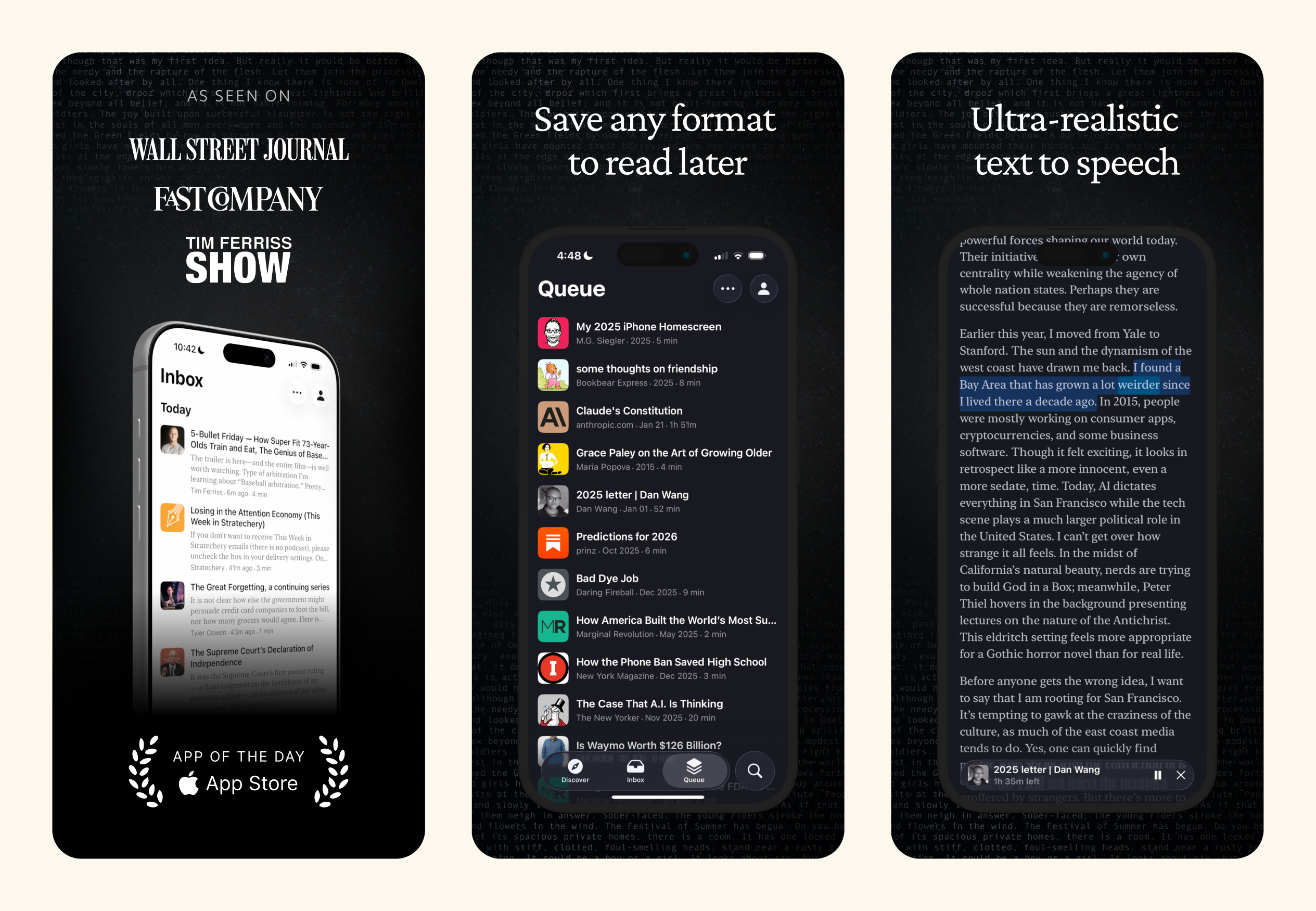
Matter is the modern read-later app for serious readers. Since Pocket shut down last fall, tens of thousands of readers have made Matter their new home.
Designed for Apple, Matter has earned multiple App of the Day honors and won MacStories’ 2025 Feature of the Year for its ultra-realistic text to speech. It’s been recommended by Tim Ferriss, Patrick Collison, the Acquired Podcast, and The Wall Street Journal, among others.

I love how Ken Liu puts it: sci-fi is fundamentally humans expressing themselves through technology. That's why I adore this genre so much. The way creators manage to transform something seemingly "cold" and "unfeeling" into heartfect stories is marvelous.
This reminds me of Liu Cixin's The Village Teacher, where a dying teacher's grueling dedication to educating children in a remote village ends up saving the entire human race.
"A lot of things described as “sci-fi” aren’t really sci-fi at all — they have very little to do with science. They’re technological stories." Sometimes, a good sci-fi story can be deeply, beautifully romantic.
It's becoming clear that with all the brain and consciousness theories out there, the proof will be in the pudding. By this I mean, can any particular theory be used to create a human adult level conscious machine. My bet is on the late Gerald Edelman's Extended Theory of Neuronal Group Selection. The lead group in robotics based on this theory is the Neurorobotics Lab at UC at Irvine. Dr. Edelman distinguished between primary consciousness, which came first in evolution, and that humans share with other conscious animals, and higher order consciousness, which came to only humans with the acquisition of language. A machine with only primary consciousness will probably have to come first.
What I find special about the TNGS is the Darwin series of automata created at the Neurosciences Institute by Dr. Edelman and his colleagues in the 1990's and 2000's. These machines perform in the real world, not in a restricted simulated world, and display convincing physical behavior indicative of higher psychological functions necessary for consciousness, such as perceptual categorization, memory, and learning. They are based on realistic models of the parts of the biological brain that the theory claims subserve these functions. The extended TNGS allows for the emergence of consciousness based only on further evolutionary development of the brain areas responsible for these functions, in a parsimonious way. No other research I've encountered is anywhere near as convincing.
I post because on almost every video and article about the brain and consciousness that I encounter, the attitude seems to be that we still know next to nothing about how the brain and consciousness work; that there's lots of data but no unifying theory. I believe the extended TNGS is that theory. My motivation is to keep that theory in front of the public. And obviously, I consider it the route to a truly conscious machine, primary and higher-order.
My advice to people who want to create a conscious machine is to seriously ground themselves in the extended TNGS and the Darwin automata first, and proceed from there, by applying to Jeff Krichmar's lab at UC Irvine, possibly. Dr. Edelman's roadmap to a conscious machine is at https://arxiv.org/abs/2105.10461, and here is a video of Jeff Krichmar talking about some of the Darwin automata, https://www.youtube.com/watch?v=J7Uh9phc1Ow